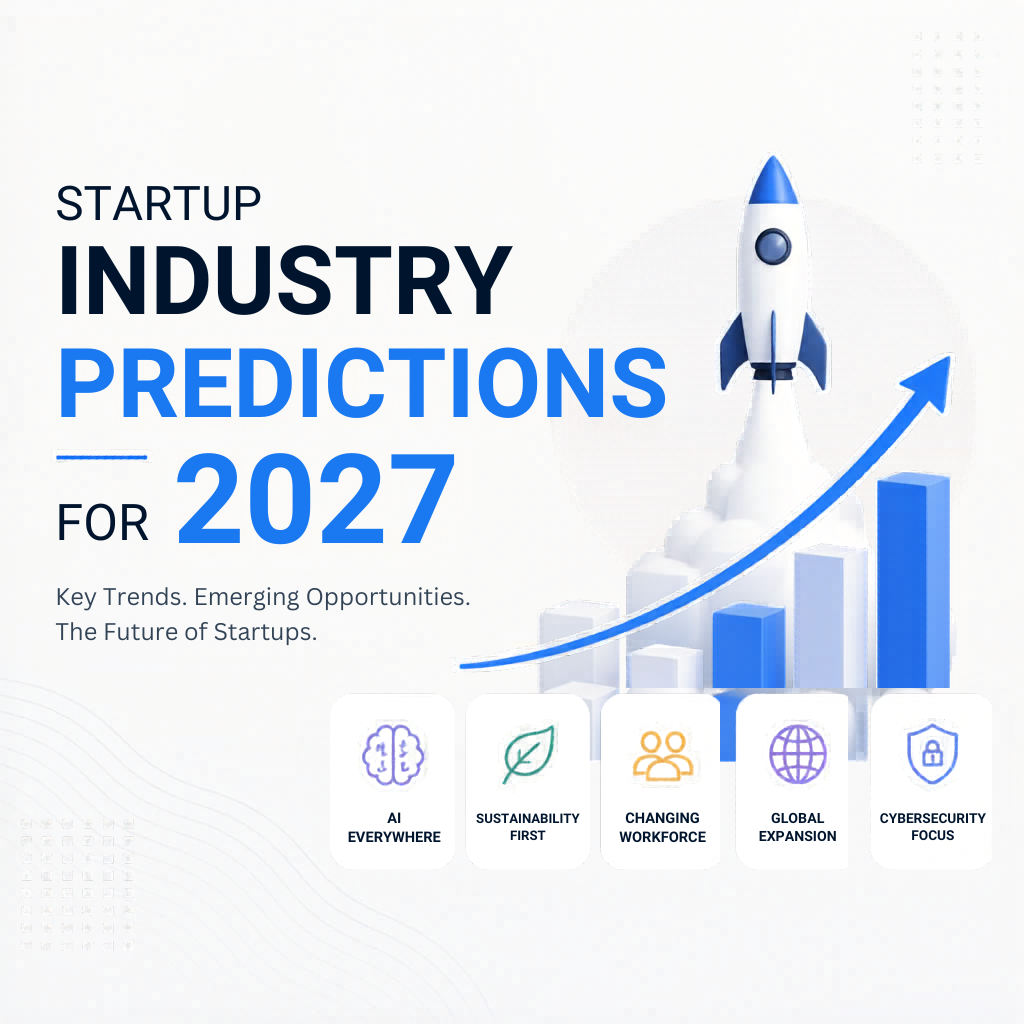
What founders, investors, and builders need to know before the next wave hits.
We are standing at the edge of a seismic shift. The startup landscape heading into 2027 bears little resemblance to the experimentation years of the early 2020s. AI has moved from hype to infrastructure. Quantum is knocking at the commercial door. Climate tech is no longer a niche bet. And venture capital, once spread across a thousand ideas, is concentrating fast.
For founders, the window to move is narrowing. Here are the seven forces that will define startup success — and failure — in 2027.
01 — AI Agents Become the New Hire
Artificial Intelligence
By 2027, agentic AI will have graduated from demo to workforce. Startups with 5-person teams will routinely do the operational work of companies that previously required 50. AI agents won’t just assist — they’ll own workflows: researching, coding, contracting, communicating.
The risk? Roughly 40% of agentic AI projects are expected to be cancelled by end of 2027 due to unclear business value and runaway costs. The winners won’t be the loudest adopters — they’ll be the most disciplined ones, integrating agents as force multipliers on specific, measurable tasks rather than replacing every human function at once.
Startups that build moats not from model performance alone, but from proprietary data and workflow depth, will be the ones still standing in 2028.
📊 46% of Q3 2025 VC funding went to AI-related startups
02 — The Quantum Land Grab Begins in Earnest
Quantum Computing
Quantum computing funding surpassed $3.77 billion in equity investment by mid-2025 — a 50% jump from the prior year. By 2027, commercially useful quantum applications will move from pilot to production in finance, drug discovery, and logistics optimization.
Here’s what’s different from previous hype cycles: 30 governments collectively announced over $40 billion in quantum programs. This isn’t just startup speculation — it’s strategic infrastructure investment. The startups that begin building quantum-ready architectures now will extract enormous value when access becomes competitive. Those who wait will be locked out of early capacity on the most capable systems.
Expect the first genuine quantum-AI convergence plays to appear: startups using quantum acceleration to train specialized models at speeds classical hardware can’t match.
📊 $3.77B in quantum equity funding by mid-2025
03 — Personalized Medicine Crosses $500 Billion
Health & Biotech
The global personalized medicine market is projected to surpass $500 billion by 2027, growing at an 11% CAGR. Genomics startups are building enormous datasets to match patients with specific treatments — and providers are paying for outcomes, not just services.
For startups, the opportunity lies in the infrastructure layer: tools that help clinicians reason over patient-specific data at scale. Wearable-enabled remote monitoring for chronic care populations is the fastest-expanding segment right now. As genome sequencing becomes routine by 2030, the startups building the rails underneath that transition will be foundational companies.
The biotech playbook has changed: it’s no longer just about the breakthrough molecule. It’s about who controls the data pipeline and the clinical workflow around it.
📊 Global genomics market projected at $186B by 2035
04 — Climate Infrastructure Becomes a Tier-1 Bet
Climate Tech
AI is reshaping the physical world — especially infrastructure, manufacturing, and climate monitoring. By 2027, climate tech will have shed its “impact investing” label entirely and become a hard commercial category. The convergence of AI with sustainability isn’t a trend — it’s a structural shift in how physical systems are managed.
Startups using AI for predictive grid management, real-time carbon accounting, and precision material discovery are drawing serious long-term capital. Carbon removal and verification tools are seeing rapid adoption as ESG mandates tighten globally. The companies that build in quantum-accelerated climate modeling will have an extraordinary edge in winning government and enterprise contracts through 2027 and beyond.
📊 Clean tech avoided 2.6B+ tonnes of CO₂ equivalent in 2024
05 — Autonomous Physical Systems Go Mainstream
Robotics & Automation
Autonomous mobile robots (AMRs) are projected to hit 2.4 million annual shipments by 2030, up from 547,000 in 2023. But the real story for 2027 isn’t the hardware — it’s the software stack that makes robots commercially viable across variable real-world environments.
Humanoid robotics, long a research showcase, will see its first genuine industrial deployments. Startups building AI-first robotic operating systems — the kind that allow a machine to adapt to a new warehouse layout without re-programming — will be the defining companies of this cycle. Surgical robotics, autonomous logistics, and smart agriculture will see the most traction as labor cost pressures and supply chain fragility force enterprises to act.
📊 Amazon surpassed 1,000,000 operational robots across 300+ facilities in 2025
06 — Capital Concentration Will Break the Middle
Venture Capital
Global VC hit $97 billion in Q3 2025 — up 38% year-over-year. But the distribution is brutal. One-third of AI funding went to just 18 companies in that same quarter. Seed funding remains accessible. But the Series A and B bridge is where most startups will die in 2026–2027.
The implication for founders: vertical moats matter more than ever. Investors are explicitly looking for startups with data moats — where each new customer or data point makes the product measurably better. Horizontal AI tools are being devalued quickly. Deep, industry-specific solutions in manufacturing, healthcare, legal, and construction are where the defensible positions are being built.
For emerging market founders specifically: deep tech hotbeds beyond Silicon Valley are opening up. The next trillion-dollar company could emerge from an unexpected geography built around a university research center or government lab.
📊 $97B global VC in Q3 2025, up 38% YoY
07 — The Era of the Niche Is Here — Own One Completely
The Founder Playbook
The most durable companies being built right now share one trait: they chose a specific problem in a specific industry and went impossibly deep. The days of building a general-purpose AI company with a shot at escaping competition from foundation model providers are over.
By 2027, the question every investor will ask is: if a frontier lab ships a 10x better model tomorrow, does your company still have a reason to exist? The ones that survive will answer yes — because their moat is in proprietary data, regulated workflows, institutional relationships, or operational know-how that no model update can replicate overnight.
Find your niche. Build the category. Become the only obvious answer to one specific, painful, expensive problem. That’s the 2027 playbook.
“The companies that start preparing now will be the ones that win in the quantum era — and the same is true of every converging technology wave heading into 2027.”
The View from Here
2027 will reward founders who are specific, patient, and data-rich. The noise is high — the signal is in depth, not breadth.